
Del Alma: An Introduction to the Exhibition
July 17, 2025
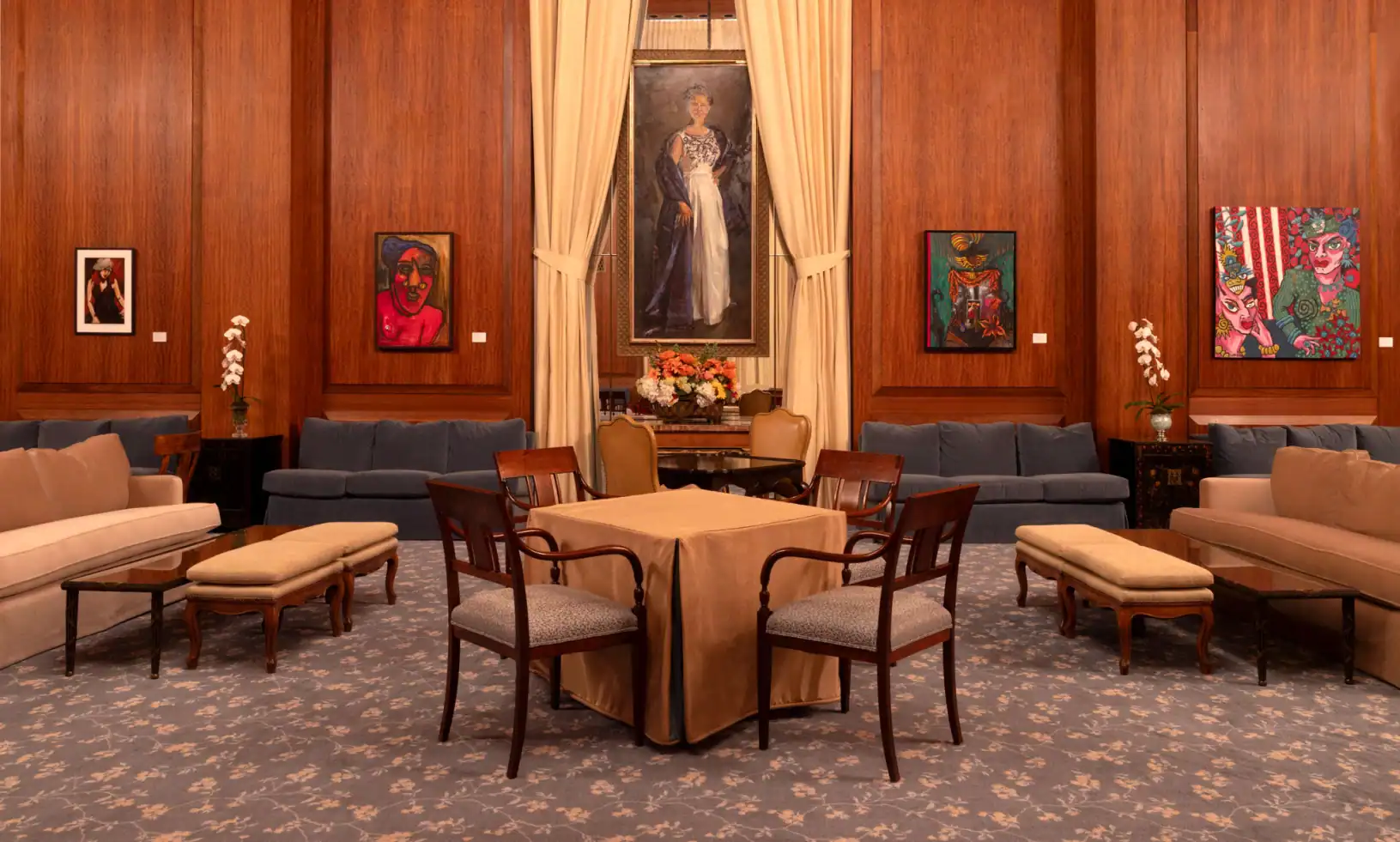
Del Alma: Latina Portraits from the Vincent Price Art Museum is an exhibition that presents an intergenerational group of portraits by Los Angeles-based Latina artists, who collectively explore portraiture and cultural identity through diverse forms of creative expression. Organized in partnership with The Music Center and on view at the Founders Room at the historic Dorothy Chandler Pavilion, the exhibition’s intimate portraits showcase how the selected artists carefully render their subject’s strength and likeness while also referencing broader themes of Latinx culture, pop aesthetics, genre painting, and matrilineal and interpersonal relationships. In this essay, I reflect on the historical movements and contemporary contexts of the Latina artists featured in the exhibition, offering a unique glimpse into the permanent collection at the Vincent Price Art Museum.
Chicanas in El Movimiento
While diverse in origin, many of the selected artists in this exhibition identify as Chicana– and are central to the canon of contemporary Chicana art history. Historically, Chicano art was a male-dominated field amid an era of political strife, racist politics, and a Eurocentric art market that often ignored art by Chicanos. This collective attitude deemed them irrelevant to private collectors or within prominent cultural institutions. During the civil-rights era of the 1960s and 70s, Chicano youth fought for empowerment within their political and social standings through protest and artistic production. ‘El Movimiento’1 manifested outwardly as a politically fueled art movement against social and political inequality amongst Chicano youth, predominantly male-led and through large-scale public murals within Los Angeles. Although women were prominent in the Chicana Art Movement, they sought to articulate more clearly their role in society.2
Excluded from mainstream galleries and public art spaces, many Chicana artists shifted towards different mediums, and by the mid to late 1970s, a great surge of (Chicana) women artists sought out possibilities of creating exhibitions of smaller, intimate and representational artworks that reflected different realities and perceptions.3 Artists featured in this exhibition like Patssi Valdez undeniably were witness to and participated in this shift of cultural and artistic production within Los Angeles.
Global Influences
Works featured in this exhibition date from the 1980s to the 2000s, with historic and global artistic influences serving as a unifying throughline, such as 20th-century art movements like German Expressionism, 17th-century Genre painting, Modern art, and Pop aesthetics. For example, artist Yolanda Gonzalez commonly evokes twentieth-century German Expressionism in her paintings. Featured in this exhibition are two of Gonzalez’s paintings titled Thoughts of Hope (1993) and Marissa with Green Hat on Red Couch (date unknown). In Thoughts of Hope, she portrays a gestural, abstract red woman with blue hair and a fang-like snout, juxtaposing the optimistic title, presenting a demon-like figure that directly confronts the viewer amid its visceral secrecy. Painted on a wooden panel, the figure features thick bold outlines, a muted color palette of swampy yellows, earthly greens, and a bright red body. Marissa with Green Hat features a commonly portrayed subject in Gonzalez’s Figurative series Marissa Gomez; her long-time muse4, on par with Gonzalez’s subject matter that often features women close to her through personal relationships and matrilineal lineage. Gonzalez’s oeuvre is heavily influenced by time spent amid her residencies abroad such as Ginza, Japan which helped shape her artistry, ultimately fusing her global influences into a contemporary Latinx and Chicana aesthetic.
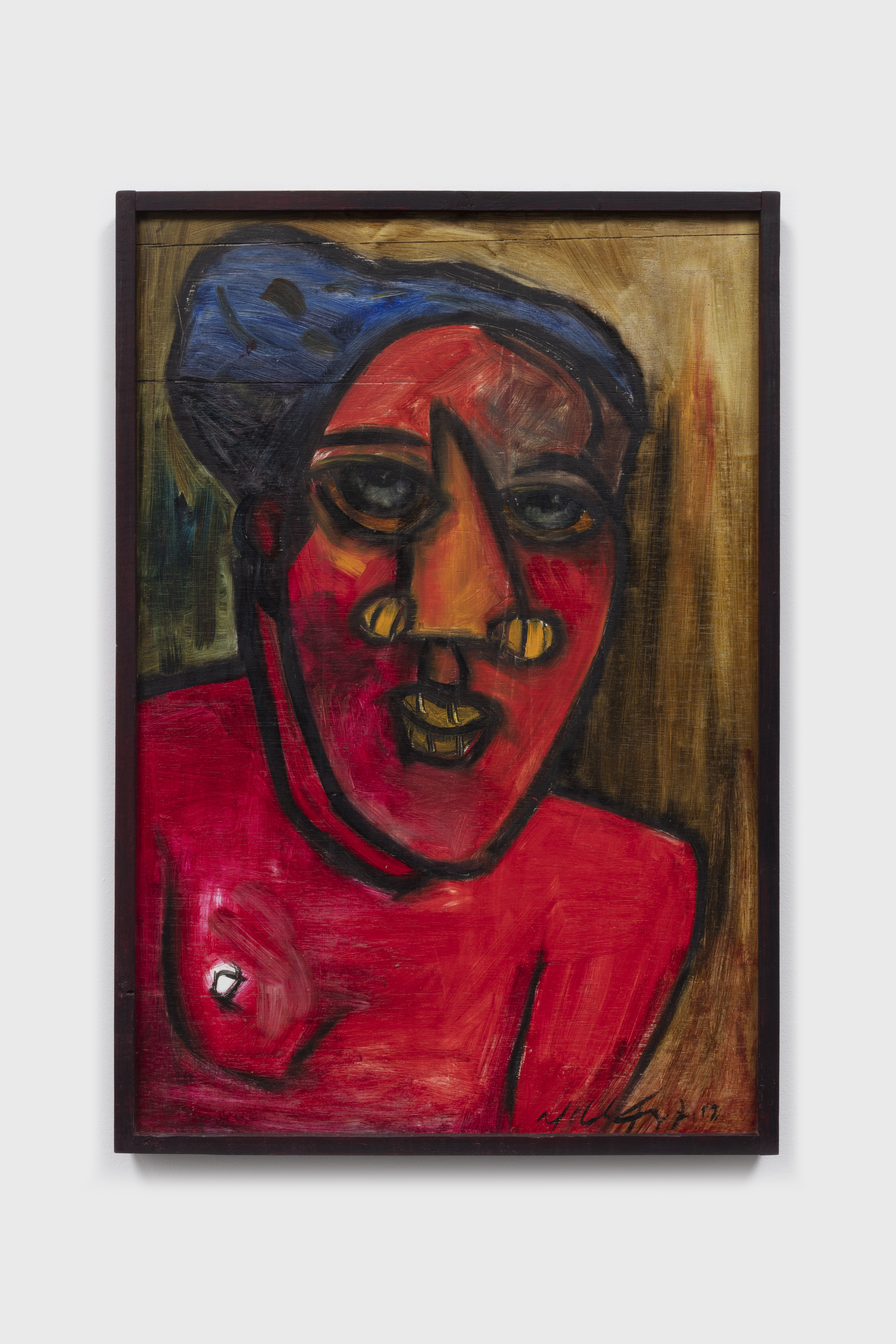
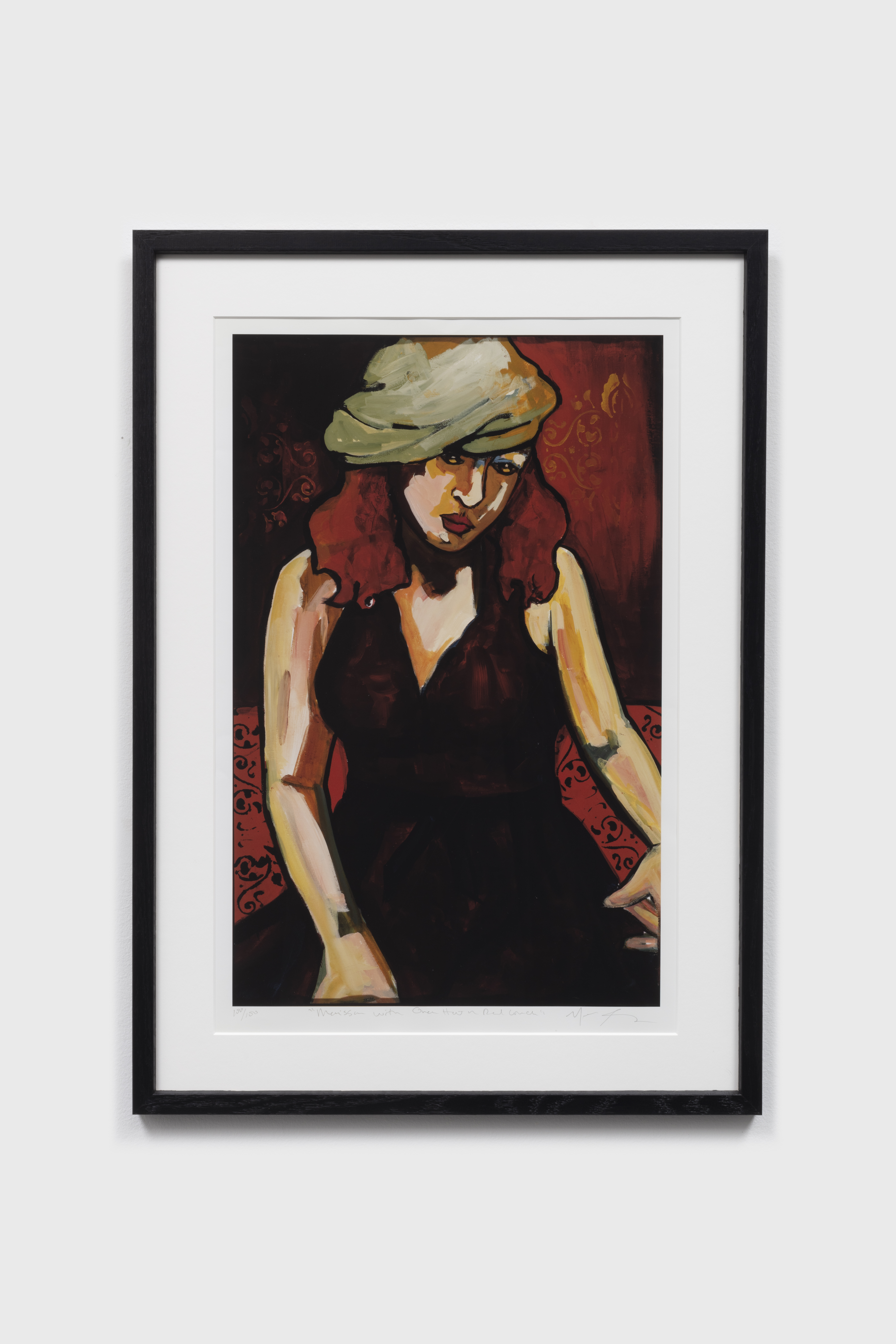
(Left) Yolanda Gonzalez, Thoughts of Hope, 1993. Oil on wood. (Right) Yolanda Gonzalez, Marissa with Green Hat on Red Couch. Date unknown, Serigraph. Photography by Joshua Schaedel. Courtesy of Vincent Price Art Museum.
Two additional artists in this exhibition, Diane Gamboa and Sonia Romero, render very distinctive styles of abstract motifs in their works commenting on the gender roles of women in society with playful, colorful, and pop aesthetics within their art practices. Both portray non-naturalistic paintings of women with themes that explore narratives of womanhood. Romeros’ painting of a young girl motif in bright blues and pinks reveals a period of adolescent transformation into adulthood and takes influences from Italian ex-votos or religious imagery. Diane Gamboa, a Los Angeles-based artist, has been producing, exhibiting, and curating visual art in Southern California since the 1980s. Experimental and diverse in her artistic practice, she is well known for her extensive range of artistry, including photography, paper fashion design, and performance art. Her paintings often include bright and saturated color palettes exploring themes of gender politics, cultural identity, and spiritualism.
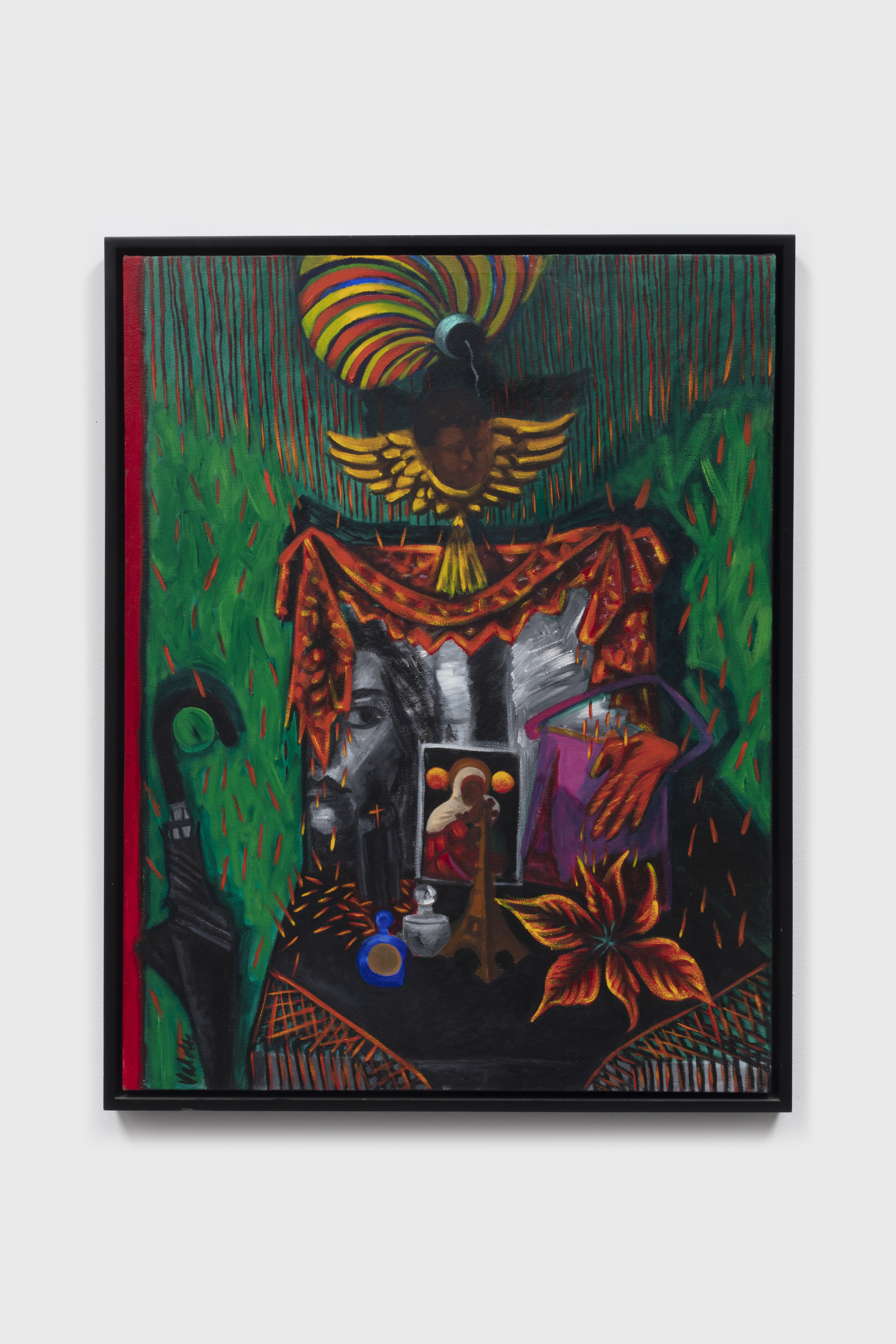
Patssi Valdez, Memories of France, 1990. Acrylic on canvas. Photography by Joshua Schaedel. Courtesy of the Vincent Price Art Museum.
While the artists in this exhibition do not need to be defined or validated in proximity to the European influences present, acknowledging these connections offers complexity to the vibrancy of these artists’ contributions to contemporary art. For example, Patssi Valdez began her artistic career in 1974 in East Los Angeles as part of the conceptual performance group ‘ASCO’. By 1990, she shifted her focus from performance art to paintings depicting domestic interior spaces. In Memories of France (1990-92), Valdez depicts an intimate scene of an ofrenda or altar clad with personal items- deferring to souvenirs from a trip abroad, perfume bottles, a mini Eiffel Tower, and a mirrored portrait featuring three-quarters of a face- presumably the artist herself. In this period, Valdez was invited to participate in a now-iconic international exhibition titled Les Demon des Anges: 16 artistes chicanos autour de Los Angeles (1989) that “cast L.A Chicanos as visionary prophets of the urban future.”5 Patssi’s intimate depictions of the interior reveal a much more personal reflection of self, in a familiar and intimate environment that has been memorialized with souvenirs abroad, that which traverse the geographic borders of East LA and reveal its international contributions.
Women in Los Angeles
With Los Angeles serving as a physical site of production and commonality among the exhibition’s featured artists, this collective group of portraits reveals how each artist carefully chose and rendered their subject’s likeness in relation to the City of L.A. Sara Palacios, a Cuban American artist, revealed to me privately that her painting “Isabelita Larreta” was inspired by a woman whom she encountered on the streets of L.A. as it “has always been her muse.”6 Her depiction of Isabelita clad with a bouffant hairstyle and dark lipstick evokes imagery of a Pachuca, a distinct Chicana youth subculture of Los Angeles most prominent during WWII.7
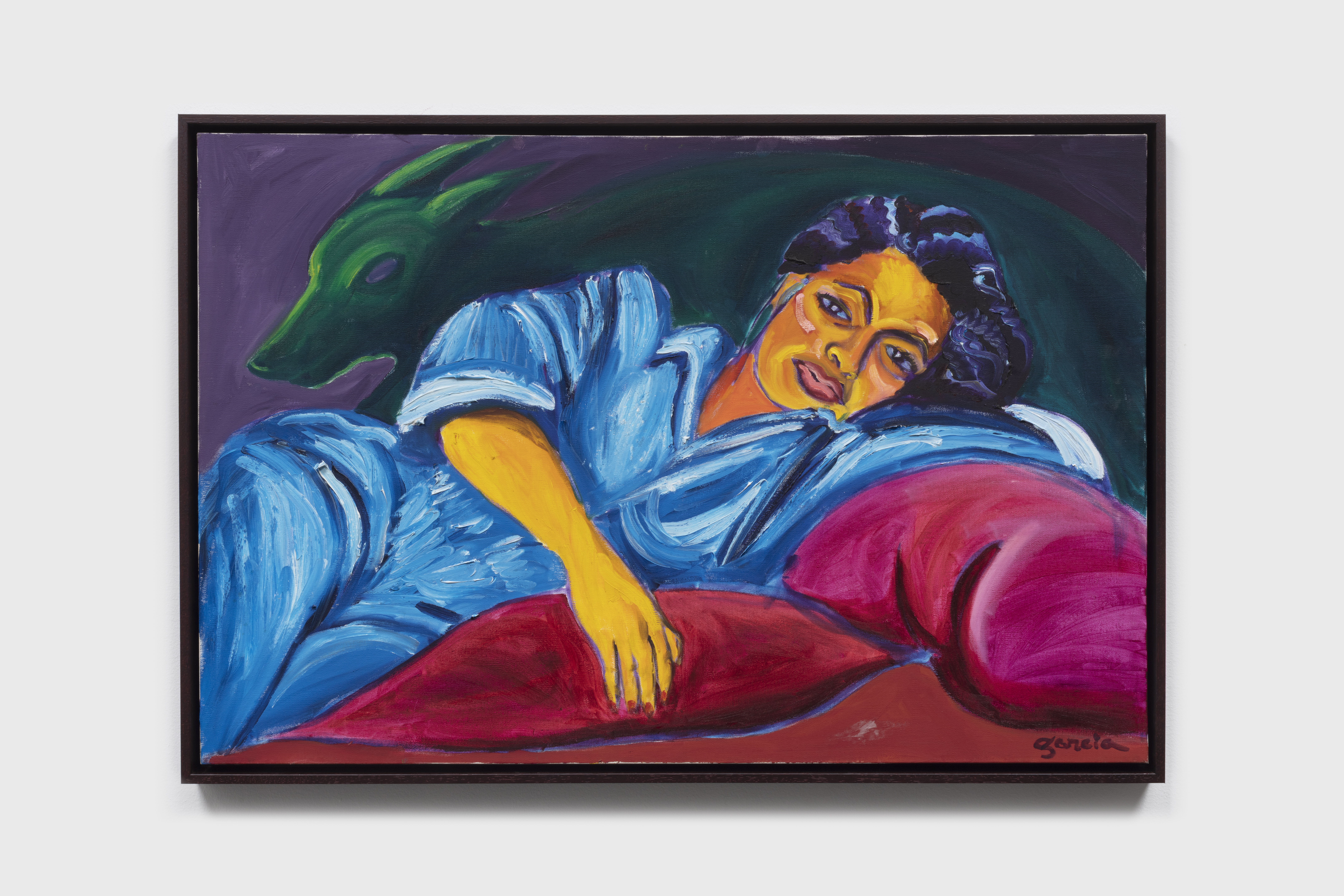
Serving as an anchor for this exhibition and selected as its feature image is a work by renowned Chicana artist Margaret Garcia. In Alma Cervantes and Her Bitch (1988), Garcia portrays Cuban-American poet and activist Alma Cervantes as the sitter. Part of the artist’s Bitch series (1984-1989), which features a reoccurring abstract dog across a variety of mediums, an animal that is docile and vicious, that which is both loved and feared. In a personal anecdote of perseverance, Garcia shared with the Austin American Statement Newspaper that this series signifies a deep and meaningful beacon of matriarchal strength. “Five years ago I was real down and out. I was a transient in Los Angeles, a new place. I’d just lost custody of my child. My grandmother died. I had to fight back. I got mad. This canine represents the most basic sense of survival for me.”8 Garcia depicts Cervantes in gestural and vibrant strokes laying on a red chaise lounge, arms cradling a pillow, with a green phantom-like dog behind her, and making eye contact with the viewer. It is almost impossible to ignore the visual connection that Alma evokes of Manet’s Olympia (1863), a revolutionary modern Impressionist oil on canvas painting that redefined the portrayal of female subjects in modern art, but Alma is vastly contemporary: bold, brown, and “not afraid to be a bitch if she has to.”9
Collectively, the paintings in this exhibition portray the complexities, themes, and influences of Latinx portraiture and the various women who have contributed to the arts within Los Angeles. Many of the artists here do not limit their practice to the constraints of classical portraiture but instead have incorporated it into their practice throughout time, directly portraying their lived realities, or abstractly referencing larger themes of gender, identity, and culture. Seeking to honor the legacy of American philanthropist and arts patron Dorothy Chandler, this exhibition presents a group of artists in dialogue with the room named in Chandler’s honor, providing an opportunity to celebrate the creative contributions of these Latina artists as subsequent generations of women who have helped to shape contemporary art and culture today.
Del Alma is on view through June 30, 2025, at the Dorothy Chandler Pavilion at The Music Center. Public visitation is available through pre-scheduled tours. All tours are presented by Music Center Symphonians, which include a 90-minute docent-led tour of the Center’s four theatres: Dorothy Chandler Pavilion, Ahmanson Theatre, Mark Taper Forum, and Walt Disney Concert Hall. To schedule a tour, visit https://www.musiccenter.org.
The Music Center is located at 35 North Grand Avenue, Los Angeles, CA 90012.
_________
Gloria Ortega is Curatorial Assistant at the Vincent Price Art Museum at East Los Angeles College, where she conducts research, organizes exhibitions, and provides project management support for exhibitions and scholarly publications. Her practice is driven by cultural histories, ancestral memory, and collaborating with artists of color in contemporary art. She has previously held curatorial and research positions at the Los Angeles County Museum of Art (LACMA), the Center for the Study of Political Graphics (CSPG), and the National Portrait Gallery. She earned an Associate in Art for Transfer (AA-T) in Art History at East Los Angeles College, and a B.A. in Art History from California State University, Los Angeles.
Featured image: Installation view, Del Alma: Latina Portraits from the Vincent Price Art Museum, in partnership with the Dorothy Chandler Founder’s Room at the Music Center, Los Angeles, on view February 20, 2024 – June 30, 2025. Photography by Monica Orozco.